San Francisco: Metropolitan Hilarion led the Consecration of Archimandrite Nicholas (Olhovsky) to the Episcopate

San Francisco: Metropolitan Hilarion led the Consecration of Archimandrite Nicholas (Olhovsky) to the Episcopate

On Saturday the 28th and Sunday the 29th of June, the Cathedral of the Icon of the Mother of God “Joy of All Who Sorrow” in San Francisco, CA played host to the national celebrations dedicated to the 20th anniversary of the glorification of the Holy Hierarch John of Shanghai & San Francisco. On Saturday at the All-Night Vigil, Archimandrite Nicholas (Olhovsky), guardian of the Protectress of the Russian Diaspora, the wonderworking Kursk Root Icon of the Mother of God, underwent Nomination as Bishop of Manhattan, vicar of the Eastern American Diocese.

On Sunday, June 29, at the triumphal Divine Liturgy and in the presence of Hierarchs of the Russian Church Abroad, Moscow Patriarchate, and Ukrainian Orthodox Church (MP), a multitude of clergy, and faithful from every corner of the U.S. and around the world, Archimandrite Nicholas was elevated to the episcopate. Later during the Divine Liturgy, the newly consecrated Bishop Nicholas ordained cathedral Subdeacon Athanasius Furgeson to the diaconate. The newly ordained Deacon Athanasius will fulfill his serve in Sts. Peter & Paul Church in Santa Rosa, CA.

Upon completion of the Liturgy, a moleben was served with a procession around the cathedral. In the presence of his brother-hierarchs, the Bishop of Manhattan was entrusted with the Hierarchal staff. Handing the newly consecrated Bishop the staff, Metropolitan Hilarion said, in part:

Your Grace, Bishop Nicholas, dear in the Lord Brother and Concelebrant!

By Divine Providence and through your election by the Council of Bishops of the Russian Church Abroad, you embark upon a new path in life and service. Through the laying on of hands, your personal Pentecost has taken place. On the day of the celebration of the saint whose uncorrupt relics abide here, St John the Wonderworker, you have joined the host of hierarchs of our dear and great Mother ‒ the Russian Church.

The Lord has prepared you for this important event since your childhood. You learned piety through the examples of your father and your late mother, who displayed for you a living image of life in Christ, rearing you in the spirit of the Church, in love for God and His saints. They infused you with love for the church and for divine services. From your youth, you came to love to make pilgrimages to holy sites, and especially to Holy Trinity Monastery in Jordanville, whose seminary the Lord led you then to study in, and to serve Metropolitan Laurus of blessed memory. Here you became a witness not only of his personal monastic labors, but his glorious victory over the many years of division within the Russian Orthodox Church.

During today’s solemn services, St John, who, just before his departure into eternity, had held in his hands the Kursk-Root Icon of the Mother of God “of the Sign,” was called the “faithful servant of the Most Pure Protectress [Hodegetria].” After the repose of your spouse, God was pleased to place you in the service of the Most-Blessed Virgin, and you accompanied the Kursk-Root Icon, the Guide of the Russian diaspora, to the parishes, hospitals and homes of clergymen and believers of many dioceses of the united Russian Church. I believe that this obedience has brought you to the priestly service, and then to monasticism. These God-pleasing obediences ‒ those of the priesthood and of monasticism ‒ should be revealed fully in your archpastoral service through self-sacrificing love for your neighbor, the mortification of your “self,” the frequent pious celebration of divine services and prayer with your flock, through your care for your clergymen, parishes and parishioners, support of monastics, the preservation of the legacy of the Holy Fathers and of the traditions of the people, “that ye receive not the grace in vain” (II Cor. 6:1).

During these Lenten days that lead us to the feast day of the “chief among Apostles,” you have received the heavenly anointing, the flame-like grace of episcopacy. In establishing this Lenten period, the Church wished to encourage all mortals to direct their inner gaze at two remarkable persons ‒ the Chief Apostles Peter and Paul. It was once revealed to Saint Hermes, one of the Apostles, that the Lord builds a tower of living stones ‒ which is the Church ascending to the Heavens, to the abode of the eternal. It was these holy Apostles who were the foundation stones of this tower, of the Church of Christ. The goal of episcopal service is this: to emulate the Apostles and become a stone worthy of the Construction of our salvation. Not all stones are suitable for the building of the Church, but only those possessing the perfection of Apostolic Faith. Upon this zeal, and upon such faith, the Church of Christ is built. It is necessary to warm within yourself zeal and thirst for “the words of eternal life” (John 6:68), through prayer, self-restraint and active archpastoral service.

And now receive this staff as a symbol of your archpastoral responsibility for the People of God, ascend the cathedra of this grand cathedral church, and make your first blessing upon the people who fervently prayed for you during Divine Liturgy, and also upon the flock that eagerly awaits you, having shared spiritually in our celebration of your episcopal consecration.

On behalf of the Eastern American Diocese, Bishop Nicholas was presented with a custom embroidered cover for a hierarchal service book.

Also praying at the triumphal divine services were the participants of the XIII All-Diasporan Youth Conference, currently taking place in San Francisco.

So now, just as more than 60 years ago, St. John has united again and again thousands of the Orthodox faithful on the West Coast ‒ those of various nationalities and from different countries, both those who lifted up their zealous prayers to God ‒ for the preservation of the world and for their loved ones ‒ as well as those who were unable to be present for the great spiritual triumph.
Media Office of the Eastern American Diocese

Paschal Epistle of His Holiness Kyrill, Patriarch of Moscow & All Russia

Paschal Epistle of His Holiness Kyrill, Patriarch of Moscow & All Russia to the archpastors, pastors, deacons, monastics, and all faithful children of the Russian Orthodox Church

Beloved in the Lord all-honorable archpastors, reverend pastors and deacons, God-loving monks and nuns, dear brothers and sisters!

On this chosen and holy day, when the world, visible and invisible (see the Canon of Holy Pascha) glorifies the Prince of life and Vanquisher of death, I send my heartfelt greetings to all of you through the Paschal exclamation:

CHRIST IS RISEN!

From year to year, the good news of the Resurrection resounds victoriously, encouraging us to render praise to God and the Savior, who has trampled down death by death and has made us participants in the eternal life to come.

As we celebrate this Feast of feasts and Triumph of triumphs, it is with a special spiritual feeling that we recall the redemptive act of the Savior of the world, His sufferings on the Cross and glorious Resurrection. Pascha is not some beautiful legend, not some theoretical theology, and not a nod toward a popular custom established in the distant past. It is the essence and core of Christianity. It is a victory given to us by God.

From the time of the apostles and up to the present, the Church has preached Christ’s Resurrection as the greatest miracle in the history of humanity. She speaks of this miracle not only as a fact of the Gospels, but – and what is especially important – as a fateful moment for all those who have received the Paschal good news. This feast bears the most direct relationship to us, for Christ’s Resurrection, the Lord’s redemption of the fallen world, is the greatest joy that the human person can experience. No matter how difficult our life, no matter what everyday troubles besiege us, no matter what grief and imperfections we have to endure from the world around us – all of this is nothing in comparison to the spiritual joy, to the hope of eternal salvation that God gives us.

As St. Paul says, “He that raised up Christ from the dead shall also quicken our mortal bodies by His Spirit that dwelleth in us” (cf. Rom. 8:11).

On this radiant day of Christ’s Resurrection, the souls of millions of the faithful are replete with thanksgiving to the Creator, and our earthly life acquires true meaning. Christ’s Pascha is the greatest triumph of life, a triumph over death, bringing love, peace, and spiritual transformation.

In celebrating Pascha, every year we open up a new period in our lives, for the Risen Lord renews human nature, fortifies us in tribulations, and grants to us strength to accomplish good deeds.

The Paschal message, which has transformed the whole course of world history, encourages us to be morally transformed, to be spiritually renewed, which is so essential for modern-day society. It reminds all people of the sources of Christianity, as well as of the coming eternal Kingdom, where “God may be all in all” (I Cor. 15:28).

In these radiant days of the Paschal feast, we are called upon to share our joy with our relatives and those close to us, to show them active love and mercy. Such are the traditions sanctified by the centuries, and in following them we testify to our participation in Christ’s inheritance, and in the belief that the Lord has truly risen.

Now, as before, the Russian Orthodox Church diligently carries out Her salvific mission, tirelessly proclaiming God’s truth, affirming the importance of the Gospel commandments, calling for peace and harmony, and serving the spiritual unity among the peoples who abide in the countries under the pastoral care of the Moscow Patriarchate.

Our special prayer today is for the peoples of Russia and Ukraine: that peace will reign in the minds and hearts of our brothers and sisters by blood and in faith, so that the ties that have been lost and cooperation, which is so vital, may be restored.

In proclaiming the love of God which surpasses all knowledge (cf. Eph. 3:19), Christianity brings people together by overcoming national, cultural, and political boundaries, for “the light of Christ illumineth all” (cf. John 1:9).

May the Risen Lord grant that we may all continue our earthly pilgrimage with benefit for our souls, recalling our lofty Christian responsibility and vocation to create within ourselves and those around us a strong faith, sincere love, and steadfast hope. May the joy of this feast strengthen and inspire us to accomplish good works, and grant to us the courage and strength amidst the stormy waves of the sea of life needed to retain our endurance and calm, to withstand temptation and trials, to overcome, in the words of Venerable Sergius of Radonezh, the hateful strife of this world.

May the light of Christ’s glory that has shone forth from the Life-Bearing Tomb abide with us and illumine our hearts, extending to those who near and far, and upon all who are in need of our care and support.

In congratulating all of you on the great feast of Holy Pascha, I prayerfully wish for you generous spiritual gifts, physical strength, and the gracious aid which is from above in our victorious journey with Christ. Amen.

+KYRILL
Patriarch of Moscow & All Russia

Moscow
Pascha of the Lord
2014 AD

PRINT VERSION 

Media Office of the Eastern American Diocese


Southern Lenten Retreat Concludes in Holy Cross Monastery

The Southern Lenten Retreat, being held for the second year in a row at Holy Cross Monastery, concluded its work on Wednesday, March 26 with a Liturgy of the Presanctified Gifts in Christ the Savior Church in Wayne, WV. The Liturgy was led by the First Hierarch of the Russian Church Abroad, His Eminence Hilarion, Metropolitan of Eastern America & New York, co-served by His Grace George, Bishop of Mayfield, abbot of Holy Cross. Concelebrating with the Hierarchs were 30 priests and deacons of the Eastern American Diocese. Also praying at the divine service were the matushkas taking part in the retreat, as well as the parish’s benefactors and parishioners.

At the Little Entrance, for his faithful service to the Holy Church and his missionary efforts, Metropolitan Hilarion awarded Archpriest John Moses (rector of Holy Myrrhbearers Church in Harrisonburg, VA) the right to wear the palitsa. Priest Demetrio Romeo (rector of St. Luke the Blessed Surgeon Mission and chaplain of the full-time Orthodox Paideia Classical Academy in Coconut Creek, FL) was awarded the nabedrennik.

Also taking part in the pastoral conference along with their husbands were the clergymen’s faithful partners ‒ the matushkas. Each of them had her own reason for participating in the retreat, and each takes a different approach to her role both in the home and in the parish.

Matushka Nancy (Anna) Crowley of St. Xenia Church in Methuen, MA, has more than 20 years’ experience in the home and parish. Her first priority is a warm and welcoming home, where she is a hospitable hostess and devoted helper to her Batushka – Archpriest Michael. This familial atmosphere easily spills over into life in their parish, where Matushka not only bakes prosphoras, but provides parishioners much-needed counsel.

Parishioners often turn for advice and comfort to Matushka Tatiana Weller of Holy Myrrhbearers Church in Harrisonburg. But Matushka, appropriately, does not take on additional and unnecessary concerns, not involving herself in complex or difficult situations, leaving the final decisions to her priest-husband.

“I always look forward to these conferences,” said Matushka Tatiana. “I like interacting and sharing experiences with other matushkas. Father and I love visiting the monastery, and when we also have an opportunity to hear talks and sermons by distinguished spiritual teachers like Fr. Demetrios (Carellas), we make it a point to attend. Fr. Demetrios’ sermon touched our hearts; he instilled hope in us and gave us spiritual support, which will long warm our spirits upon our return to the world.”

In his sermon in Christ the Savior Church, Fr. Demetrios – a Greek with a deep knowledge of Russian Orthodoxy ‒ used as one of his examples of selfless love and wholehearted devotion to Christ the 19-year-old Russian soldier Evgeny (Eugene) Rodionov, brutally martyred during the Chechen War for his refusal to convert to Islam. Such living instruction cannot fail to touch the heart!

Matushka Solomonia Wing of St. Nicholas Church (MP) in Edinboro, PA made a conscious decision to take several days off from life in the world during the Great Fast, in order to focus on the spiritual life:

“These gatherings and interaction help me better understand how to explain to my children why they should be a part of the Orthodox Church and active members of their parish, why they should attend services, and the importance and meaning we give to Great Lent. These same questions are often posed by our adult parishioners, too. You have to give them answers, but even more often, I’m sure, the example they are going to follow in the parish is the one set by the priest and matushka.”

For the first time, matushkas participating in the retreat had their own separate program ‒ a master class led by Matushka Lubov Lukianov, during which she taught her sisters how to bake lenten ‒ and simultaneously delicious ‒ piroshki and pastries.

“This conference is organized intentionally with both clergy and matushkas in mind. During the Fast, we come together to pray and interact with one another. Many American matushkas come from the South, don’t speak Russian, and are unfamiliar with Russian customs. That is why I decided to share some of what I know with them,” said Matushka Lubov. “In many parishes in old Russia, matushkas would bake and sell piroshki and bread. Even large cathedrals have been raised up, thanks to these labors by matushkas. I myself have long been using a good, light recipe for preparing piroshki with potato filling or pasties with mushrooms, and I offered these recipes to our matushkas. This was all new to them, and they took a great interest, happily rolling piroshki and making the fillings. I hope that, returning to their parishes, they will be able to spread these Russian traditions to their parishioners.”

Metropolitan Hilarion thanked the matushkas for their active participation in the conference, after having seen the fruits of their interesting, useful, and delicious master class.

Upon completion of the Liturgy, many deserved words of thanks sounded out: first to Bishop George, for his incalculable hospitality and spiritual support for the retreat’s participants; to Fr. Jonah Campbell (rector of Christ the Savior Church) and the benefactors and parishioners, for the opportunity to celebrate the Liturgy together in their capacious and beautifully adorned church; to Archimandrite Demetrios, for spiritually fortifying and instructing the clergy and lay participants. Eastern American Diocesan secretary Archpriest Serge Lukianov thanked the hierarchs ‒ Metropolitan Hilarion and Bishop George ‒ for their participation and the time they had dedicated to everyone in need of edifying words, instruction, spiritual support, and the close human interaction with one’s Archpastors so badly needed by every priest. He invited all to take part in the celebrations dedicated to the 80th Anniversary of the Diocese, which will take place in Howell, NJ this November. Fr. Serge addressed many more warm words to his brother clergy, who found it necessary to carve 3-4 days out of their schedules in order to come and participate in the retreat, “especially when everyone spends a full day at work, in addition to responsibilities in the parish and at home.”

In the second half of the day, having communed of Christ’s Holy Mysteries, obtained invaluable experience interacting with senior clergy, inspired and spiritually renewed by the prayerful atmosphere in one of the primary and fastest growing monasteries in the Russian Diaspora, and with a penitent heart following the Presanctified Liturgy, the clergy and matushkas returned to their parishes.

Courtesy of the Eastern American Diocese of ROCOR website (also contains photos)

Metropolitan Hilarion’s Epistle on the occasion of the 80th Anniversary of the Founding of the Eastern American Diocese

Epistle of His Eminence HILARION
Metropolitan of Eastern America & New York
First Hierarch of the Russian Orthodox Church Outside of Russia
to the Clergy, Monastics, and Faithful of the Eastern American Diocese
on the occasion of the 80th Anniversary of the Founding of the Diocese

Reverend Fathers, Venerable Monastics, Brothers and Sisters in Christ,

This year, we celebrate the 80th anniversary of the founding of the Eastern American Diocese by the ever-memorable Archbishop Vitaly (Maximenko) in 1934. This anniversary gives us reason to stop and assess the 80-year path that has passed before us, while making provisions for a brighter future. The Lord has been merciful to us sinners, and has blessed our Diocese with peace and prosperity throughout its history. It is a history that has been intertwined with the catastrophic events of the 20th century, which left our Russian homeland and most of Europe in ruins after decades of war and revolution.

As we celebrate the past eighty years, our joy is bittersweet because we cannot ignore the events that have been transpiring around us in the world. The moral and political landscape of the world is rapidly changing for the worse; it is once more a hostile time for Christians. Our youth are facing trials of temptations that breed sinister spiritual despair. When we think about what the next 80 years might bring, we must be prepared to stand firm in our faith against a world that will war against us as it wars against Christ and His Church. For this reason, Christ our Savior warned his followers: “If ye were of the world, the world would love his own: but because ye are not of the world, but I have chosen you out of the world, therefore the world hateth you” (John 15:19). Christ also comforted them, saying: “In the world ye shall have tribulation: but be of good cheer; I have overcome the world” (John 16:33).

In order to heed the words of our Savior, our vision for the future must be built upon the rock-solid spiritual foundation laid out for our Diocese by Archbishop Vitaly, all the First Hierarchs of the Church Abroad, and other pillars of Orthodoxy, such as Archbishops Nikon (Rklitsky), Averky (Taushev), Andrei (Rymarenko), and the countless priests, monks, and laymen who toiled alongside them over the past eight decades. They understood that words, regardless of how eloquent they may be, will not be enough to inherit the Kingdom of Heaven. They heeded the words of our Savior when He said, “Not every one that saith unto me, Lord, Lord, shall enter into the Kingdom of Heaven; but he doeth the will of my Father which is in Heaven”(Matthew 7:21).

For eighty years, the Diocese has made a great effort to discern the will of the Father, making His will our priority, which has led to our inspiration and joy. Despite the temptations of the outside world, life in the Church has been peaceful and fruitful. Let us look back and remember the hundreds of reverend clergy who were ordained and served our Diocese throughout its 80-year history. How many thousands more were saved through the Holy Church because of these pastors and monastics? Every Divine Liturgy that has been served in all of our churches and monasteries over the course of 80 years has been a triumphal proclamation of Christ’s victory over the world! Every communion of the Holy Mysteries has brought people into the salvific fold of the Church, making them members of the one Body of Christ. Prayer and the divine services are the air that the Church breathes, without which life in Her, and union with Her Head – Christ ‒ is impossible! If we continue to live our lives within the saving fold of the Church, we shall have no cause for worry or despair when faced with the trials and temptations of the world, for we know that we are safe with Christ in His Holy Church, against which even “the gates of hell shall never prevail!”

We call upon all of you to strengthen your prayers and continue expanding your involvement in the daily life of the Church. We have been blessed in the Eastern American Diocese with faithful, talented, and dedicated clergy, who have been appointed to their positions through the grace of the Holy Spirit to be the shepherds of all of the souls entrusted to them by God. While financial and physical contributions are important and necessary to the life of the parish, the highest priority of every Orthodox Christian must be to attain eternal salvation through the saving bosom of the Church. If our primary focus is the salvation of our souls, then all earthly concerns over finances and administration on both a parish and diocesan level will either resolve themselves or become clearer and easier to understand.

Glory be to God, the past five years have been a period of steady growth in our Diocese, both in the administrative sphere and on a local level. Our parishes are growing, new clergy are being ordained, missionary efforts are being expanded, and our flock is now larger and more multifaceted than ever before. In an effort to keep up with the growing demands of operating our vast Diocese, we have blessed the creation of a new diocesan center at Saint Alexander Nevsky Cathedral in Howell, NJ. This decision came after much prayerful deliberation with members of the Diocesan Council and a full review of the specific needs of a potential diocesan center. The cathedral will officially become the episcopal See of the Ruling Bishop of the Eastern American Diocese and the administrative center of the Diocese on September 12, 2014.

We believe that this vision for a new center is the fruitful vine, sprung from the seeds planted by our founder. In all of his monastic wisdom, Archbishop Vitaly foresaw the bright future of Saint Alexander Nevsky Church and the important role that it would play in the strengthening of our Eastern American Diocese. Having founded this parish as his first in America, he said: “I pray God that this, my firstling, the parish of Saint Alexander Nevsky, might flourish as a tree planted at the waters.” Together, we must strive to fulfill the will and testament of our founder by building a center there that will serve not only the administrative needs of our Diocese, but most importantly – the spiritual needs of our faithful. The new center must act as a safe spiritual harbor for our clergy and faithful, where they can unite together in prayer and brotherly love, regardless of their ethnicity or language. To do this, we must cultivate within ourselves the chief virtue of every Christian – love. “By this shall all men know that ye are My disciples, if ye have love one to another,” said our Lord and Savior Jesus Christ (John 13:35).

The triumph of Christ’s love over worldwide evil is the cause of our celebration during this 80th anniversary. In order to cultivate this love within our hearts, let us be mindful of the words of Saint Nektary of Optina, who said: “Pray that the Lord will rule in your heart. Then it will overflow with great rejoicing and happiness, and no kind of sorrow will have strength to disturb it.” This is how we are called to live and grow with Christ. This is how we must thank our Creator and celebrate all of the accomplishments of the past 80 years, and this is most assuredly the feeling that will rule our hearts when we gather together in our Diocesan Center to celebrate the Divine Liturgy.

We invite all of you to come to St. Alexander Nevsky Cathedral on November 14-15, 2014, to experience this feeling of Paschal joy as we gather to honor and thank our Lord for all that He has done for us. This celebration will strengthen our faith and remind us of the need for fortified spiritual vigil, a firm stand for the pure and unadulterated Faith, and devotion to the Truth of the Church, which holds this Faith sacrosanct in the face of worldwide apostasy. If we hold to these principles, the state of our Diocese will remain strong.

With love in Christ,

+HILARION
Metropolitan of Eastern America & New York
First Hierarch of the Russian Orthodox Church Outside of Russia

February 23/March 9, 2014
Triumph of Orthodoxy

Courtesy of the Eastern American Diocese of ROCOR Media Office

Newly Formed Music Institute to train Orthodox Choir Conductors and Singers in North America

Approximately 2,500 churches and monasteries comprise a melting pot of cultures and liturgical traditions that define Orthodox North America. 1,000 of those churches belong to the Russian Orthodox Church and the Orthodox Church in America, both of whom are deeply rooted in the 1,000 year history of Orthodox Russia. One of the most visible signs of similarity between these jurisdictions is the Russian style of liturgical singing, which is vastly different from the Greek and Antiochian traditions. OCA and Russian churches predominantly sing the services a cappella, which requires a choir and a competent conductor. Choir conferences and short term training courses are organized by most Orthodox jurisdictions in America, but there has not been a unified program or formal institute where conductors and singers can receive their training.

In an effort to better train church musicians, representatives from most major musical programs and seminaries in ROCOR and the OCA gathered together at the end of 2013 to form the Patriarch Tikhon Russian-American Music Institute (PaTRAM). The work of the newly formed institute was blessed by the Primates of the Orthodox Church in America and the Russian Church Abroad. Building on the work that has been done by music educators in the past, PaTRAM strives to provide continuity through its progressive training programs at every level of Church musical development in both English and Slavonic.

In 2013, PaTRAM reached an agreement with Vladimir Gorbik, conductor of Moscow’s Holy Trinity-St. Sergius Lavra’s Representation Church choir, to collaborate on a program designed specifically for people living in North America who want to learn church singing and directing. This program is founded on the same process used for church music and choral direction training at the Representation Church in Moscow, developed by Gorbik and representing a synthesis of the spirituality of Holy Trinity-St. Sergius Lavra and the professional education offered at the Moscow State Conservatory. Over the last ten years, this educational method has been helping people of different professions who had no prior musical or choral education become church singers and choir directors, and has been no obstacle to their professional lives.

Understanding that most choir conductors and singers in America are not able to take weeks off from their personal and work schedules, PaTRAM offers comprehensive training programs through the Internet. Weekend classes are conducted at various times and in different parts of the country, but the primary goal of PaTRAM is to create an accessible virtual institute to build competence over longer training intervals. The programs do not require the student to have a musical education, because the intent is to take anyone with musical potential and teach him to sing or conduct. Those who already have musical training can further their education through the Master’s program.

One of PaTRAM’s unique characteristics is its desire to unite professionalism with prayer. To demonstrate the potential of prayerful singing by professionals who are also believers, in September 2013 PaTRAM launched the Patriarch Tikhon Choir under the direction of Vladimir Gorbik. Three concerts were organized in New York City, Pittsburgh, and Washington, DC as part of the choir’s world premiere. (Click here for a New York Times review of the concert.)

PaTRAM has also partnered with the Media Office of the Eastern American Diocese of ROCOR to produce a documentary about the work and goals of the institute. The 25-minute film, entitled “Uniting Musical Excellence with Orthodox Worship,” gives an overview of the important role of music in the life of the Orthodox Church and explains how PaTRAM is embarking on an endeavor that could potentially revolutionize the way that the Orthodox conductors and singers receive their musical training in North America.

For more information or to register for classes, please visit the official website of the Patriarch Tikhon Russian-American Music Institute at www.patraminstitute.org.

Media Office of the Eastern American Diocese of ROCOR


Feast of Theophany in Eastern American Diocesan Parishes and Monasteries

On Sunday, January 19, the clergy and faithful of the Eastern American Diocese joyously celebrated the great feast of the Baptism (Theophany) of our Lord Jesus Christ. On the day of the feast, when “the nature of the waters is sanctified,” it is proper to perform the Great Blessing of the Water. But the number of parishes that additionally perform blessings of local bodies of water grows every year.

Below are photographs of the feast of the Theophany in various diocesan parishes and monasteries. We ask that all parishes wishing to participate in this project send pictures to the Media Office’s e-mail address (eadwebmaster@gmail.com) at their earliest convenience.

Jordanville, NY – Holy Trinity Monastery

Nanuet, NY – Holy Dormition Convent “Novo-Diveevo”

Franklin, NY – Holy Trinity Church & St. Innocent’s Retreat Center

Dominican Republic – Kazan Mother of God Mission

Richmond, ME – St. Alexander Nevsky Church

Red Bank, NJ – St. Nicholas Church

Columbia, SC – St. Elizabeth the New Martyr Church

Wayne, WV – Christ the Savior Church (photos by Anton Shelepov)

Charlotte, NC – Reigning Mother of God Church

Mebane, NC – Holy Trinity Church

Courtesy of the Media Office of the Eastern American Diocese

Theophany of Our Lord

Service Schedule:

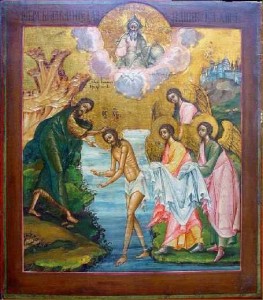
icon-of-the-theophany-of-our-lordFriday, January 17:
Forefeast of Theophany
6:30pm – Royal Hours & Typika

Saturday, January 18:
Eve of Theophany
9:40am – Hours (w/ Confessions)
10:00am – Liturgy
2:00pm – Great Vespers & Blessing of Waters
5:30pm – Vigil (w/ Confessions)

Sunday, January 19:
Theophany
9:40am – Hours (w/ Confessions)
10:00am – Liturgy
12:00pm – Blessing of the River
1:00pm – New Year’s Potluck Meal

About the feast of Theophany:
Troparion Hymn
“When Thou wast baptized in the Jordan, O Lord, the worship of the Trinity was made manifest; for the voice of the Father bare witness to Thee, calling Thee His beloved Son. And the Spirit in the form of a dove confirmed the certainty of the world. O Christ our God, Who hast appeared and hast enlightened the world, glory be to Thee.”

HOLY THEOPHANY

The Baptism of our Lord Jesus Christ is one of the twelve great feasts, one which is celebrated with no less solemnity than is the Nativity of Christ. One might say that the Nativity and the Baptism are two related holidays comprising one single celebration, the Feast of Theophany, for together they present to us the appearance of all three Persons of the Holy Trinity. In the cave in Bethlehem, the Son of God was born according to the flesh, and at His Baptism, from the Heavens the Holy Ghost descended in a bodily shape like a dove upon Him (Luke 3:22) and the voice of God the Father was heard, saying, Thou art My beloved Son; in Thee I am well pleased! (Luke 3: 22)

Holy Hierarch St. John Chrysostom writes that “it is not the day of the Savior’s birth that we should call His Appearance, but the day on which He was baptized. He did not become known to all by His Birth, but by His Baptism, and that is why it is not the day of His Birth that is called Theophany, but the day on which He was baptized.”

We can say the following about the actual Baptism of the Lord: Our Lord Jesus Christ, who had returned from Egypt after the death of King Herod, grew up in Nazareth, a small town in Galilee. With His Most-holy Mother, he remained in that small town until he was thirty, earning a living for himself and the Most-holy Virgin by following the craft of his supposed father, the Righteous Joseph, who was a carpenter. Upon attaining thirty years of earthly life (i.e. the age before which according to Jewish law one was not permitted to teach in the synagogues or accept the rank of priest), it was time for Him to appear to the people of Israel. However, before that moment, according to the prophets, there first had to appear to Israel the Forerunner, the one who bore responsibility for preparing the people of Israel to receive the Messiah, the one of whom the Prophet Isaiah prophesied: the voice of him that crieth in the wilderness, Prepare ye the way of the Lord, make straight in the desert a highway for our God (Isaiah 40: 3). Far from the people, in the depths of the severe Judaean Desert, the word of God came unto John, the son of Zacharias (Luke 3: 2), unto a kinsman of the Most-holy Virgin, who while still in the womb of his mother, the Righteous Elizabeth, leaped for joy to welcome his Savior, the One about Whom no one on earth except His Most-pure Mother, who had received the Good News from the Archangel, yet knew. That word of God directed John to go out into the world to preach repentance and to baptize Israel, to bear witness of the Light, that all men through him might believe. (John 1: 7).

Heeding God’s word, John walked throughout the land of Jordan, preaching the baptism of repentance for the remission of sins (Luke 3: 3). The whole Jewish land and the residents of Jerusalem went out to hear his preaching, to be baptized by him in the waters of the River Jordan, and to confess their sins (Mark 1: 5). Among the Jews who came to John there naturally arose the question: Was he Israel’s hoped-for Redeemer and Comforter? The Baptist replied: There cometh One mightier than I after me, the latches of Whose shoes I am not worthy to stoop down and unloose. I indeed have baptized you with water: but He shall baptize you with the Holy Ghost… (Mark 1: 7-8). And lo, on one of those ordinary days, as John was preaching to the Jews gathered at the Jordan, he was inspired by the Holy Spirit, and recognized among the people the One before Whom thirty years earlier he had leaped in his mother’s womb. Jesus had come from Galilee to Jordan to be baptized, along with everyone else, by John. John forbade Him, saying: I have need to be baptized of Thee, and comest Thou to me? (Matthew 3: 14). Seeing the Son of God, Who was not subject to sin, before him, John asked that he himself, who was under the sin of disobedience, which had passed from Adam to all of mankind, be baptized by Jesus Christ. And Jesus answering said unto him: Suffer it to be so now, for thus it becometh us to fulfill all righteousness… (Matthew 3: 15). Sinless and incorrupt, born of the Most-pure Virgin Mary, and in His Divinity the source of all purity and holiness, He had no need of that Baptism. However, as He had taken on Himself the sins of the entire world, he had come to the waters of the Jordan to purge them through Baptism. He came to be baptized, so as to sanctify the waters with Himself, so as to grant us the font of Holy Baptism. He also came to be baptized so that John might see the fulfillment of God’s word directing him to come out of the desert: Upon Whom thou shall see the Spirit descending, and remaining on Him, the same is He which baptizeth with the Holy Ghost. (John 1: 33).

St. John the Baptist obeyed Christ’s words, and the Jordan received into its waters the One by Whose command it had began to flow. According to the Gospels, after being baptized the Lord immediately came out of the water. Regarding that “immediately” Church tradition states that St. John the Baptist would hold anyone coming to be baptized neck-deep in the water until he had confessed all of his sins. Only after doing so would the person be allowed to come out of the water. Christ, Who was without sin, could not be held in the water, and therefore immediately came out of the river. As He was coming out of the water, the Heaven was opened, and the Holy Ghost descended in a bodily shape like a dove upon Him, and a voice came from Heaven, which said, Thou art My beloved Son; in Thee I am well pleased! (Luke 3: 21-22). Just as, in the days of Noah, the dove announced that the flood waters had receded, so here the dove pointed to an end to the flood of sin. The Holy Spirit appeared to the people in the form of a dove because that bird was the symbol of love, purity, and meekness. Thus the Holy Spirit is the source of purity, the bottomless depth of love for man, the teacher of humility and peace.

According to Church tradition, St. John the Forerunner’s preaching and his Baptism of the Savior took place at the site of the ancient crossing over Jordan, approximately 5 km from the river’s entrance into the Dead Sea. Already in the times of King David, a ferry had been set up there, and in the 19th Century the place was referred to as “Pilgrims’ Ford,” on account of the multitude of pilgrims coming together there to be washed in the waters of Jordan. It was by that path that 12 Centuries before the Savior’s Nativity, ancient Israel, led by Joshua son of Nun, entered the Promised Land. It was there that, one thousand years before the Divine Incarnation, King David went beyond Jordan, fleeing from his own son Absalon, who had risen up against him. It was at that site that the prophets Elijah and Elisha crossed the river. Later, already during the Christian era, Venerable St. Mary of Egypt departed by that way for the desert beyond Jordan to weep over her sins. Today, the nearby Greek Monastery of St. John the Forerunner reminds pilgrims of the events of Theophany which transpired there.

Back in Apostolic times the Holy Church had already been celebrating the day of Holy Theophany; among its ordinances it bequeathed the direction: “may you hold in great reverence the day upon which the Lord showed us Divinity.” Since antiquity, and in remembrance of the Baptism in which Jesus Christ descended into the waters of Jordan, the Orthodox Church has performed the Great Blessing of the Waters, both on the eve of the Feast and on the actual Feast. The Order of Service for the Blessing of the Waters, and the grace imparted to the water on the Sochel’nik, the Eve of Theophany, and on the actual Feast of Theophany, are one and the same. The solemn Blessing of the Waters stems from the tradition of the Church of Jerusalem, where already in the first centuries of Christianity; solemn processions to the River Jordan for Blessings of the Waters to commemorate the Savior’s Baptism were made. From antiquity in the Church of Russia as well, there have been solemn Blessings of the Waters both on the Eve and on the Feast of Theophany.
-Courtesy of the Russian Orthodox Cathedral of St John the Baptist, Washington DC